Aladdin: the characters
Aladdin is one of the "orphan tales" of the Nights: it has no medieval Arabic manuscript and was first written down in French by Antoine Galland in 1712, from the telling of the Syrian storyteller Hanna Diyab of Aleppo. The 1001 trilogy returns to that older shape, with a sorcerer from the Maghreb, two spirits (of the ring and of the lamp), the trick of "new lamps for old" and a villain who comes back in disguise.
Aladdin
Street boy, master of the jinn
Aladdin is fifteen, quick-handed and quick-tongued, raised by his widowed mother in the poorest lane of the city. A magician crossed the desert for him and buried him alive for a brass lamp; the boy came out of that cave with a jinn at his command and the same open heart he went in with. He wants the Sultan's daughter — and later gives up his own servant to save her. That generosity is his real magic.
Appearance. Fifteen, wiry, dark curls, a patched over-tunic and a grin that has talked him out of trouble more than once.
Personality. Warm, impulsive, generous to a fault; kid-simple in his wants ('Take me home.' 'I want her.').
“A war? ... A war.”
Appears in: Aladdin and the Lamp, Aladdin and the Princess, Aladdin at War
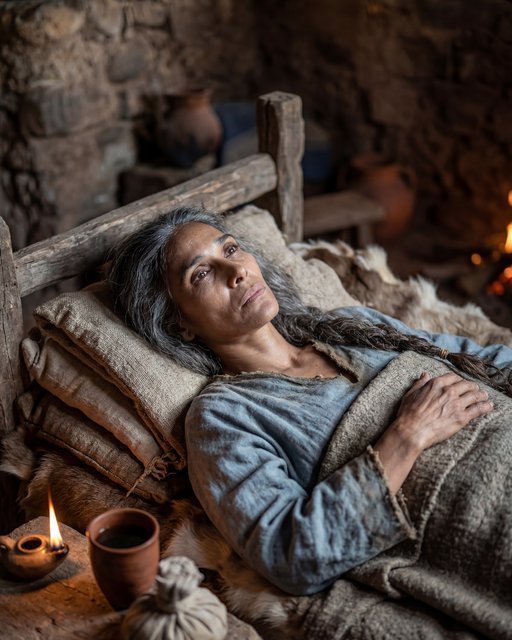
Aladdin's Mother
Aladdin's mother
She has spent her life keeping a roof over her boy in the poorest lane of the city, and she does not entirely trust the fortune that arrives with him. Still, when he asks, she wraps herself in her best, walks the cave-jewels into the palace herself, calls the Sultan's bluff, and comes home having begun a war on her son's behalf.
Appearance. Late thirties, worn but dignified, a plain veil and careful hands.
Personality. Warm-Arabic, calls Aladdin 'habibi'; practical, brave when it counts.
“Habibi — what have you brought into this house?”
Appears in: Aladdin and the Lamp, Aladdin and the Princess
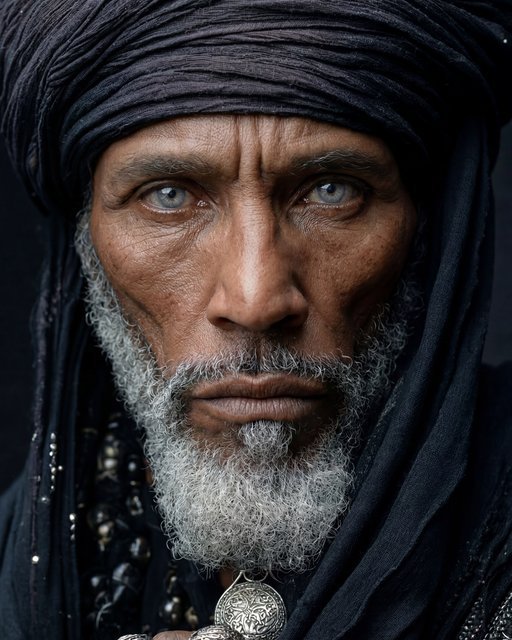
The Maghrebi
The sorcerer from the Maghreb
The Maghrebi is patient the way the desert is patient. He crossed a continent for the lamp, buried a boy for it, and comes back from the grave stronger each time. By his third return he has wished himself into the most powerful shapeshifter alive — a sorcerer who can wear a friend's face, a father's voice, any shape that gets close enough. Only a gazelle's nose can tell the real him from the mask.
Appearance. Tuareg-coded — deep indigo embroidered robes, silver jewellery, an ornate dagger, pale grey-blue eyes. Later, any face he chooses, with a faint cobra-scale shimmer as the tell.
Personality. Dry, unhurried, cosmic menace; false-warm when wearing a loved one's face.
“You will walk free tonight.”
Appears in: Aladdin and the Lamp, Aladdin and the Princess, Aladdin at War
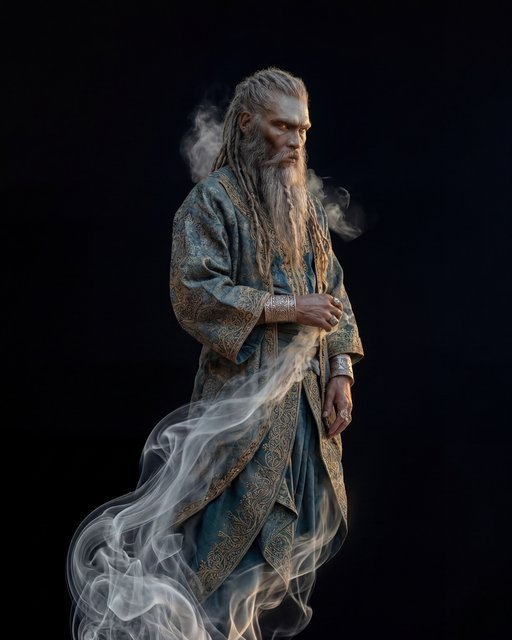
Rohaan
The spirit of the lamp
Rohaan is old enough to have watched cities rise and fall, and he answers to whoever holds the lamp — not to any three-wish bargain. Awe and dread, with a rogue's charm underneath; long ago he loved another spirit, the jinn of the ring, and has never quite gotten over it. When Aladdin finally wishes him free, he fights at full power for the boy who let him go.
Appearance. An ancient sage — white-silver hair and beard, gold flecks at the temples, a single deep amber eye that does not glow, his lower body dissolving into black-and-gold smoke.
Personality. Ancient gravity with a charming, incorrigible streak; never silly.
“A war.”
Appears in: Aladdin and the Lamp, Aladdin and the Princess, Aladdin at War

Princess Bodour
The Sultan's daughter
Bodour (from Badr al-Budur, 'the full moon') is composed, watchful, and weary of being wanted for her title. She sees through performance, values purity of heart over wealth, and saves her warmth for her little sister Aya. She tests Aladdin in secret and chooses him for his heart; later, when the palace is torn into the sky around her, she refuses to bow.
Appearance. Late teens, kohl-lined eyes, silks and gold, a diadem she wears like a weight.
Personality. Composed, discerning, quietly defiant; agency before she speaks.
“Gold. And more gold. Is that all the world ever sends me?”
Appears in: Aladdin and the Lamp, Aladdin and the Princess, Aladdin at War
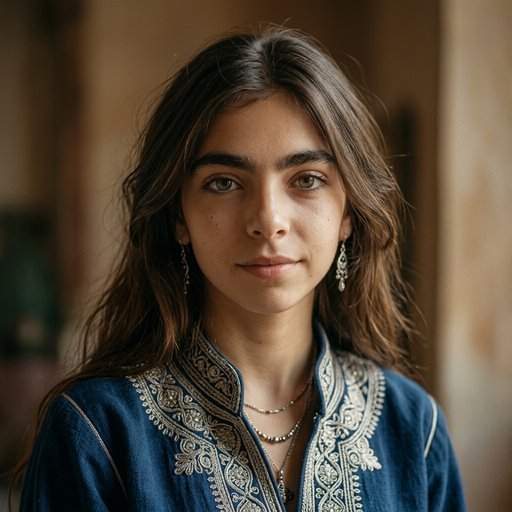
Aya
Bodour's little sister
Aya is the palace's only unguarded voice: she blurts the truth adults will not, adores her tame gazelle Ghazal, and loves shiny things. She trades the old lamp for a new one without understanding what she has done — and in the next tale, sick with guilt, slips out alone to steal it back, and becomes the unlikely hero of the war.
Appearance. A small girl in a princess dress at first; later a huntress outfit with one sash kept from the old dress.
Personality. Bright, fast, honest; guilt drives her into courage.
“It was just an old lamp. I brought you a nicer one.”
Appears in: Aladdin and the Princess, Aladdin at War
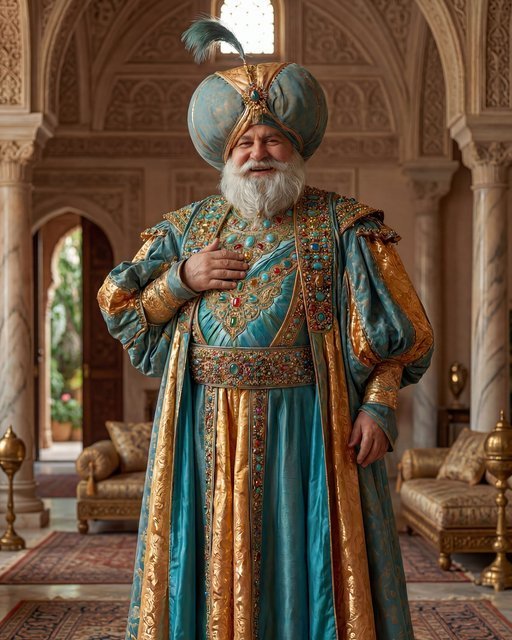
The Sultan
Bodour's father, ruler of the kingdom
The Sultan loves his daughters and loves a good show, and the second weakness keeps overruling the first. He is charmed by Aladdin's jewels, bullied by his Vizier, and comic through weakness rather than malice — a father who means well and keeps being out-maneuvered.
Appearance. Sixties, robed and jewelled, a soft face under a heavy turban.
Personality. Vain, indulgent, warm; easily led.
Appears in: Aladdin and the Princess, Aladdin at War
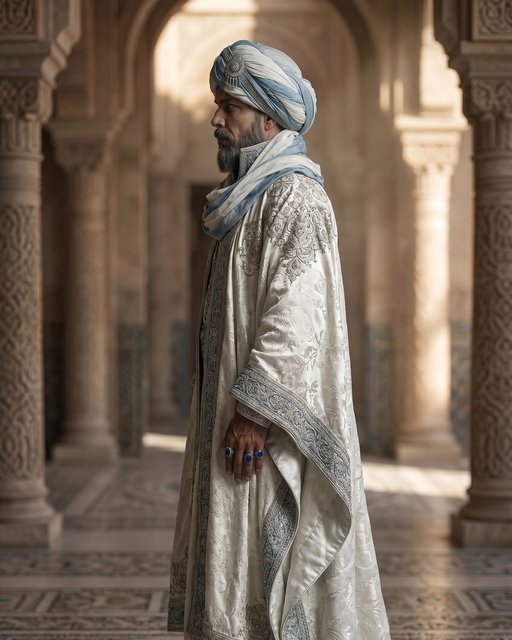
The Grand Vizier
The Sultan's minister
The Grand Vizier is the human villain of Part 2's first half — cold, status-obsessed, and nursing wounded pride after his son is humiliated. He speaks in insinuation and never quite says the cruel thing outright, working the vain Sultan like an instrument.
Appearance. Lean, grey-bearded, dark robes of office, a chain of rank.
Personality. Cold, proud, indirect.
“A name, majesty. Surely the man has a name.”
Appears in: Aladdin and the Princess
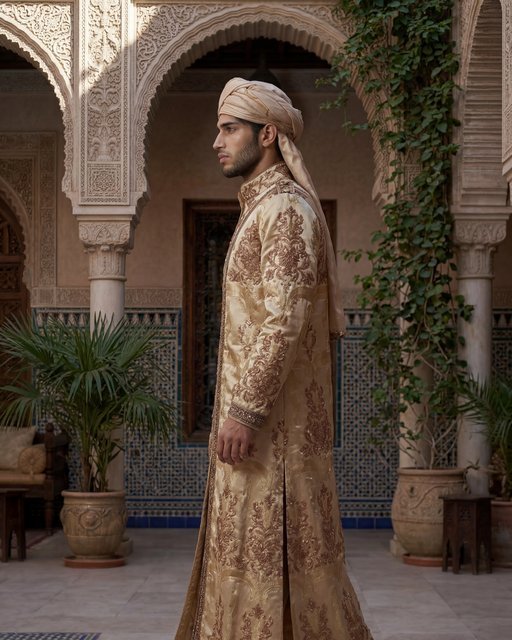
The Vizier's Son
The rival groom
The Vizier's son is his father's instrument and the episode's comic casualty. Married off to Bodour against her will, he spends his wedding nights deposited by an invisible jinn somewhere worse each dawn — the privy, the fish-pond, the top of the minaret — raving about a demon no one believes, until the match collapses.
Appearance. Young, over-dressed, increasingly disheveled.
Personality. Preening, then unravelling into a gibbering wreck.
“There! There it is again — the demon!”
Appears in: Aladdin and the Princess

Ghazal
Aya's tame gazelle
Ghazal is Aya's tame gazelle and confidant, mostly noble and occasionally comic. She balks at the disguised peddler when no one listens; in the war that follows, her nose cuts through the sorcerer's every disguise, and it is her hoof — not a hero's blade — that ends the most powerful sorcerer alive.
Appearance. A slender desert gazelle, dark liquid eyes, a beaded collar.
Personality. Noble, watchful, loyal; her warning bray is the story's danger motif.
Appears in: Aladdin and the Princess, Aladdin at War
Samaa
The spirit of the ring
Samaa answers from a brass ring rather than a lamp, and appears only in great distress — first glimpsed in 'The Treasure,' fully herself in the war. Estranged from Rohaan for a thousand years, she is the sharper and warier of the two: quick to shield him and quicker to grumble about it. Aya's terror wakes her, and she becomes the child's guardian, before a boy's heart out in the desert calls her away again.
Appearance. A spirit of smoke and light, cooler-toned than Rohaan, appearing only when her master is in danger.
Personality. Exasperated, dry, fiercely protective; the old-married foil to Rohaan.
“Rohaan — is that you? You haven't learned a thing.”
Appears in: Aladdin at War
Episodes
 Aladdin and the LampPart 1 — the boy the sorcerer came for24 min · 2026
 Aladdin and the PrincessPart 2 — winning her was only the beginning24 min · 2026
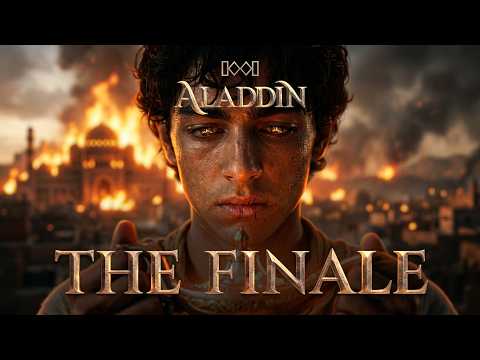 Aladdin at WarPart 3 — the sorcerer returns wearing a thousand shapes27 min · 2026
 Aladdin — The Complete SagaAll three chapters as one 75-minute feature75 min · 2026